How to Choose an Executive Desk: A Guide to Size, Material and Layout
June 28, 2026 · 6 min read
A practical buyer's guide bringing together everything to consider when choosing an executive desk — from room dimensions and materials to storage and the coherence of a complete management suite.
An executive desk often defines the character of a room at first glance. But the right desk is never only about appearance: being the right size, made of the right material, and arranged in the right layout determines whether that desk will be comfortable to use for years. This guide is written to turn choosing an executive desk from an aesthetic preference into the sum of measurable decisions.
At NSON, we look at this subject through a manufacturer's eyes. Because we carry out design, production, and installation under one roof in our workshop based in İnegöl/Bursa, we see firsthand which detail of a desk makes a real difference in daily use. The sections below lay out the questions you should ask yourself while researching an executive desk.
Room Size and Desk Proportion: Which Length for How Many m²?
The first step in choosing an executive desk is to realistically measure the space it will occupy. As a general balance rule, there should be at least 90-100 cm of clearance on every side of the desk for comfortable circulation and chair distance.
As a rough guideline, executive desk dimensions can be considered as follows:
- 12-16 m² room: A straight desk 160-180 cm wide is sufficient and well-proportioned.
- 16-24 m² room: A 180-200 cm desk, preferably together with a pedestal or side unit.
- 24 m² and above: A 200-240 cm desk or an L-shaped executive desk, leaving room for a guest area.
An oversized desk makes a small room feel cramped; a small desk in a large office weakens its gravitas. The goal is to proportion the room to the desk, not the desk to the room. The door swing direction, window position, and the location of cable outlets should also be noted at this stage.
L-Shaped Desk or Straight Desk?
This decision relates directly to the way you work. A straight (rectangular) desk offers a clean, formal stance; it is ideal for setups where meetings happen at a separate table and the screen and documents are kept in front.
L-shaped executive desk models, by combining two surfaces, provide more working area and a natural division: one wing serves the computer and daily work, while the other handles paperwork, signing, and brief conversations. For executives with heavy document traffic who like to keep several tasks on the surface at once, the L layout delivers a distinct comfort.
A practical criterion: if you spend most of the day at the screen and on a single focal point, a straight desk suits you; if you constantly move between materials, files, and short conversations, an L-desk is more fitting. In an L layout, deciding which side (right/left) the return wing opens toward — based on the room's entrance direction — also makes for smoother use.
Material and Durability: Wood Veneer, Lacquer, Leather, Metal
Material determines both the character and the lifespan of an executive desk. Each material carries its own stance and maintenance requirement.
- Wood veneer (natural veneer): Carries the grain and warmth of real wood; gives a dignified, timeless look. With the right varnish and edge banding, it is long-lasting. Every panel's grain is unique.
- Lacquered surface: Offers a flat, matte or glossy, modern look. Color flexibility is high; quality lacquer resists scratching and fading, though the quality of the surface workmanship is decisive here.
- Leather detail: Usually used as a desk-top working pad or a front-panel accent; it adds tactile comfort and prestige. The choice between genuine and synthetic leather should be judged by intensity of use.
- Metal: Used as a leg, sled base, or detail, it brings a modern line and load-bearing strength. Powder-coated metal is durable against wear.
The real determinant of durability is not the visible surface but the body material, edge workmanship, and connection hardware. A moisture-resistant body, well-bonded edge banding, and quality runners and hinges keep the desk as good as new a decade later. As a manufacturer, our experience shows that what truly keeps a desk standing is these out-of-sight details.
Pedestal, Bookcase, and Credenza: The Storage Layout
The value of an executive desk is measured not only by its top surface but by the orderly storage it provides. Defining your needs in advance prevents clutter later.
- Pedestal: A drawer unit attached to the desk or mobile. It is the primary solution for daily documents, stationery, and personal items. A lockable drawer matters for confidential paperwork.
- Bookcase/shelving unit: Positioned behind or beside the desk, it gathers files and folders and keeps the working area clean.
- Credenza: A low cabinet usually placed behind the desk; it offers both storage and a display surface on top, adding coherence to the office.
In choosing storage, the question of "what kind" matters as much as "how much": is the emphasis on folders, digital equipment, or personal items? The right balance of closed and open storage secures both function and a tidy appearance for the room.
Cable Management and Ergonomics
In a modern executive desk, the invisible details are as important as the visible ones. Cable management comes first among them: a desktop cable grommet, an under-top cable tray, and a power/data module eliminate the sight of tangled wires. When these details are anticipated in the design rather than added afterward, the result is far cleaner.
On the ergonomics side, a few measurements make the difference:
- Working height: Standard desk height is in the 72-75 cm range; its harmony with the seating height should be assessed together with the chair.
- Knee clearance: Sufficient width and depth should be left under the desk for comfortable seating; the pedestal position must not narrow this space.
- Screen distance: Desk depth (usually 80-90 cm) should be enough to keep the screen at a distance appropriate for eye health.
Good ergonomics directly reduces the fatigue felt at the end of the day and increases the long-term value of the desk.
Coherence as a Management Suite: Desk, Chair, and Guest Seating
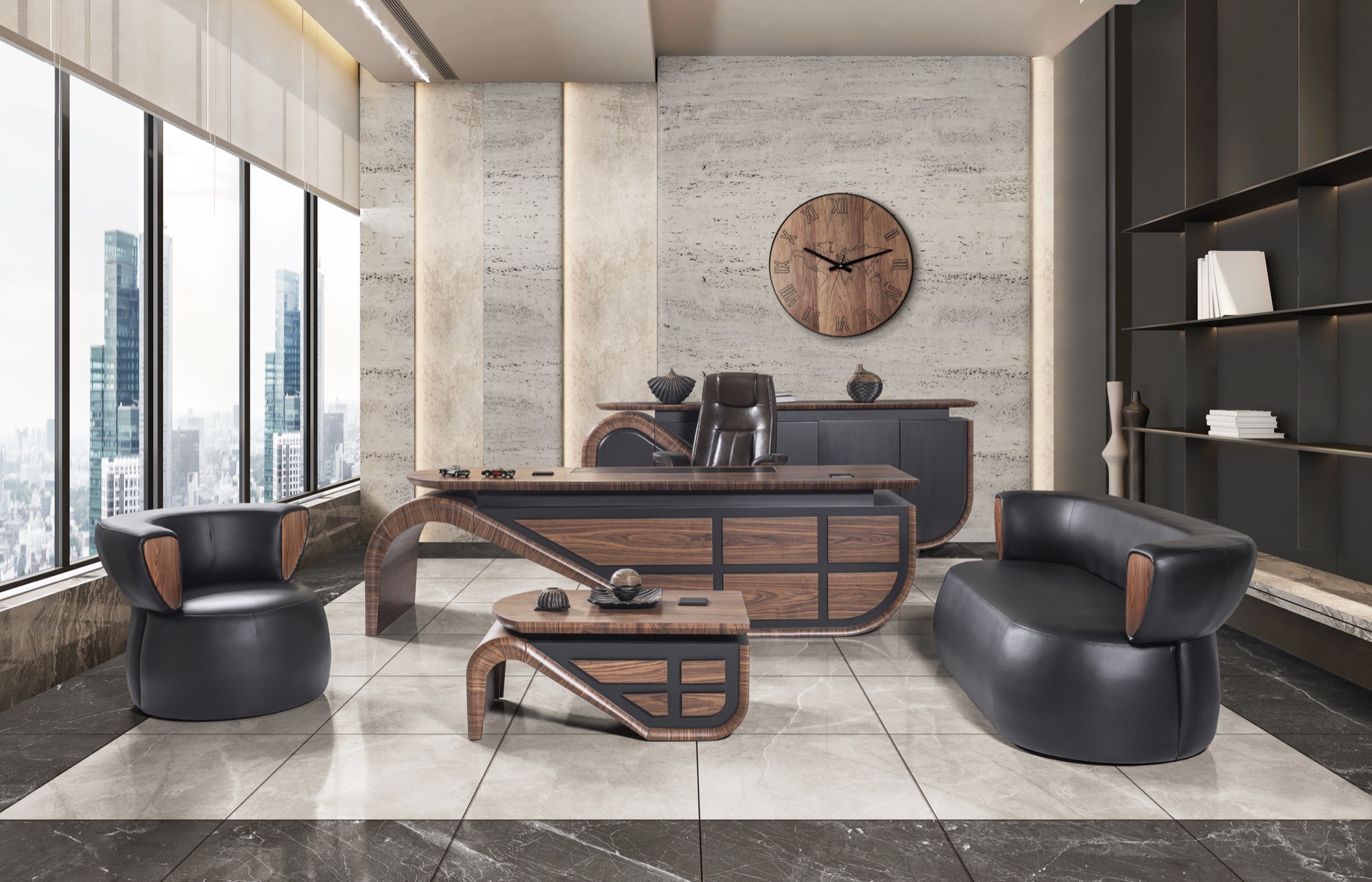
An executive desk is rarely evaluated on its own. The room as a whole — desk, executive chair, guest chairs, and storage units — gains its true character when it speaks the same design language.
Points to watch in a management suite:
- Chair harmony: The executive chair should match the desk's material and color tone, while guest chairs should be proportionate to seating comfort and the scale of the room.
- Guest arrangement: Two guest chairs in front of the desk or a separate meeting area should be planned according to the room's intended use.
- Material continuity: Keeping the wood tone, metal detail, and fabric/leather choice consistent throughout the room leaves a considered rather than a scattered impression.
Making piece-by-piece furniture sit together well is not always easy. The most concrete benefit of carrying out design, production, and installation under one roof appears precisely here: color tone, dimension, and detail planned in harmony from the very start.
NSON's executive suite collection is designed with this coherence as its foundation. In corporate projects, we handle every component — from an executive's desk to the guest area — under one roof, with dimensions and material options specific to the project. When you share the size and usage pattern of your room, we can determine the most suitable layout together and, depending on your needs, propose standard models or project-specific solutions.
The right executive desk is not a purchase but a long-term corporate decision. Getting the size, material, and layout right from the outset keeps that decision right for years.
Related Pages